

When AI Can't Capture: The Things Algorithms Miss
The metadata of human feeling exists in physical traces that digital capture erases.
The metadata of human feeling exists in physical traces that digital capture erases.
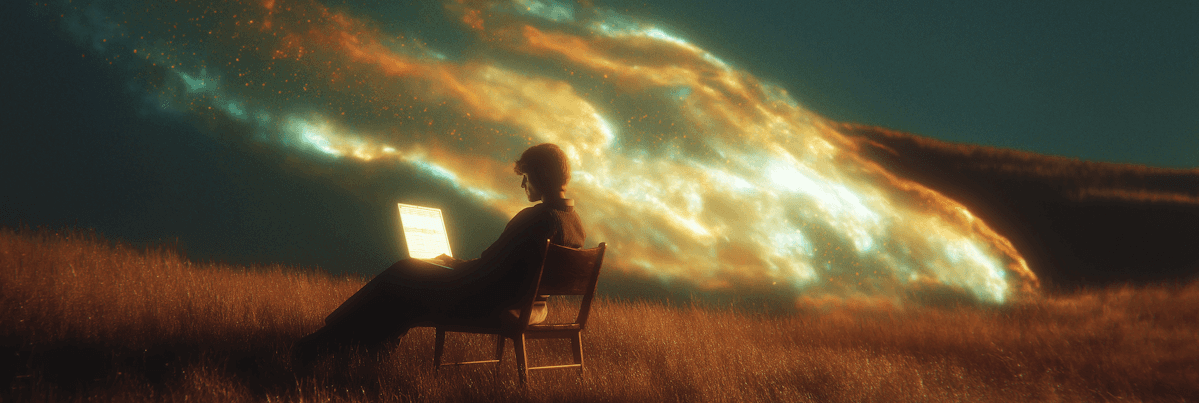
Somewhere, a tech company's AI analysed ten thousand love letters and produced one of its own in under four seconds.
My dearest, your eyes sparkle like stars. My heart beats only for you.
Technically correct. Sentimentally appropriate. Completely, hollowly empty.
I read it and felt nothing, which is exactly the problem, and also, if I'm honest, exactly the point.
There are things that resist being captured. Not because they're complicated, but because they exist in dimensions that data cannot enter. They live in the tremble of handwriting when someone is trying not to cry. In the crossed-out word that tells you what they almost said.
In the specific way your nani signed her name, that particular loop in the last letter that was entirely hers and that no font will ever replicate and that you would recognise anywhere in the world without being told why.
They live in the pause before someone says I love you for the first time, the particular quality of winter light through the kitchen window at half past seven in the morning, the smell of your childhood home that you cannot describe to anyone but would know instantly in the dark.
These things are real. They are, arguably, the most real things there are. And they are exactly what the algorithm cannot touch.
We have been promised that technology will capture everything. AI transcribes our conversations. Photo apps organise our memories by faces and dates and locations.
Mood-tracking apps ask us to reduce our inner weather to an emoji, a number out of ten, a data point in a graph that goes back six months and tells us we were happier in September.
But something is lost in the reduction. Something that is, in fact, the whole thing.
A handwritten letter is not just its words. An AI can analyse its sentiment, identify its structure, even replicate its tone.
What it cannot know is why the ink changes colour halfway down the page, because the writer got up to make tea and came back changed. It cannot read the wrinkled corner, worried soft from being folded and unfolded and read again in the small hours.
It cannot feel the places where the pen pressed harder into the paper, whether from emphasis or from tears or from both at once. The metadata of human feeling lives in physical traces, in the texture of the thing itself, and that is precisely what disappears the moment you scan it.
I think about my mother's recipe book. Not the one she typed up and sent in a Google Doc, properly formatted with measurements and timings, which is useful and which I use. The other one.
The old one, falling apart at the spine, with her handwriting getting smaller as she ran out of space, with a smudge of something orange near the halwa recipe that is almost certainly haldi and is somehow, to me, more precious than anything the internet has ever given me.
That smudge is her. That shrinking handwriting at the bottom of the page is her, running out of room, fitting everything in. No app can archive that. No AI can generate an equivalent. And even if it could, that is not what the smudge is for.
This isn't a complaint about technology. I use it too, constantly, gratefully. It's something narrower than that. It's just a recognition that some things are diminished by the very act of trying to preserve them.
The inside joke that makes no sense outside its context and that you're not even sure you could explain. The wordless understanding between old friends, the kind where someone looks at you across a room and you both know, without any of it being said.
These are not inefficiencies. They are not gaps waiting to be filled by a better model.
They are the point.
AI is genuinely remarkable at patterns. At producing, very quickly, things that statistically resemble meaning. What it cannot do is the irreducible particular: the thing that matters precisely because it happened once, to specific people, and cannot be scaled or replicated or fed back to you as content.
The love letter that made you cry was not crying at the grammar. It was crying at the person. At the proof that someone had sat somewhere and meant it, specifically, for you.
That's the thing the algorithm keeps missing. Not the feeling. The for you.