


Stranger Things Showed Us the Ending Nobody Else Will
Most shows lie to you at the end. Stranger Things did something harder. Something truer. And I don't think enough people have said that out loud.
Most shows lie to you at the end. Stranger Things did something harder. Something truer. And I don't think enough people have said that out loud.
They gather everyone in a room, or on a porch, or at a wedding, and they give you the version of closure that feels earned after eight seasons of chaos.
Everyone is okay. Everyone is together. The camera pulls back and the music swells and you are allowed to leave feeling that things resolved the way things, in real life, almost never do.
Stranger Things did something harder. Something truer. And I don't think enough people have said that out loud.
The final scene doesn't give you a reunion. It gives you a room.
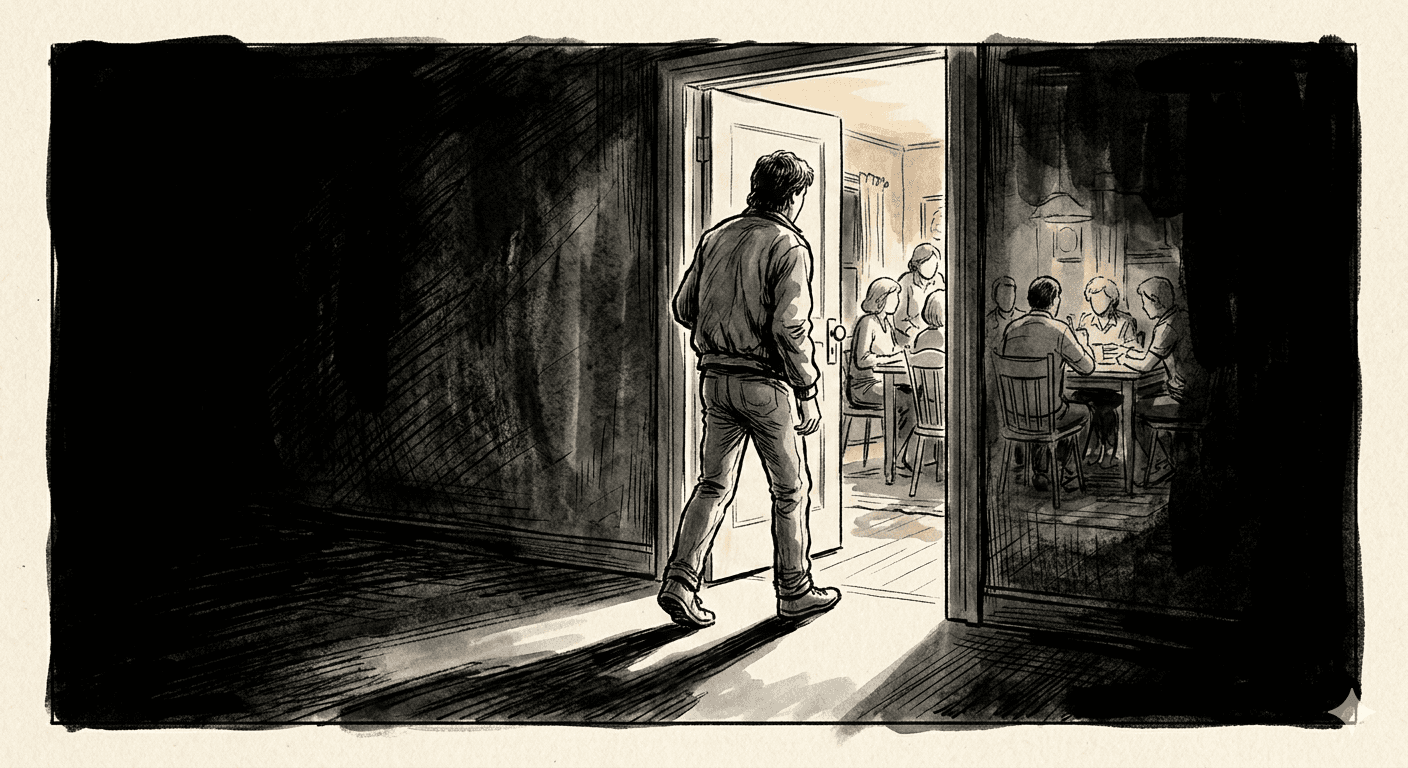
Mike Wheeler stands in the doorway of a basement that held an entire childhood, watching a group of younger kids settle in to play Dungeons and Dragons, taking up the exact space he and his friends once occupied with the whole urgent seriousness of people who believed the fate of the world depended on them. He stands there for a moment, looking back at what was.
And then he steps out.
That is the whole thing, right there. In one quiet shot.
Upstairs, or on a rooftop, or somewhere above the ordinary noise of Hawkins, the older ones talk. Nancy. The boys.
The conversation is the kind you have when you're standing at the edge of something and you know it, when the future has already begun arriving and the past is still close enough to touch.
Someone has a teaching job at a local school. Someone else is in a city now, building a life that belongs to a different geography. They talk about the town the way you talk about a person you love and are slowly learning to live without.
No villain was defeated in that final scene. No gate was closed. What happened was quieter and more permanent than any of that.
Things changed. The way things actually change, not in a moment of drama but in the accumulated weight of separate lives pulling gently in separate directions, until one day you realise that the group chat has gone quiet and meeting even once a month is no longer something you can guarantee, it is something you have to schedule three weeks in advance and even then someone can't make it.
The people who felt this scene the most weren't the teenagers who grew up with the show. They were the ones in their late twenties and early thirties, people who watched the first season in college common rooms or small rented flats and are now, ten years later, living exactly the ending that Stranger Things just put on screen.
They recognised it not as fiction but as documentation. This is how it goes. This is how it already went, for most of us, somewhere between 26 and 32, without ceremony, without a final scene, without a song to mark the moment.
Which brings you to the song.
When I'm back in Chicago, I feel it. It plays over those final images like something that was always going to be the last word. You can take the person out of the place, but you cannot take the place out of the person. The town stays in you. The basement stays in you.
The people you played games with and fought alongside and loved in the clumsy, total way you love people before life teaches you to hold back, they stay in you.
Even when the meetings become rarer. Even when the calls get shorter. Even when you are standing in a city that is entirely your own and belongs to no version of your past self, and still, some evenings, you feel it.
This is what growing up actually looks like. Not the dramatic break, not the tearful farewell at a train station. Just a boy standing in a doorway, looking back at a room that already belongs to someone else, and understanding, without anyone having to say it, that this is how endings work.
They don't close. They just quietly become the beginning of something else.
That is the most honest thing a television show has done in years. And it was about a group of kids fighting interdimensional monsters in a small American town in 1986, which tells you something about where the truth hides when you're not looking for it.
It hides in the last look back before you step through the door.
It hides in the song that plays when you return to the city that made you.
It hides in the way we all, eventually, walk upstairs from the basement, blinking in the ordinary light, carrying everything we found down there and learning, slowly, to carry it alone.